01Overview
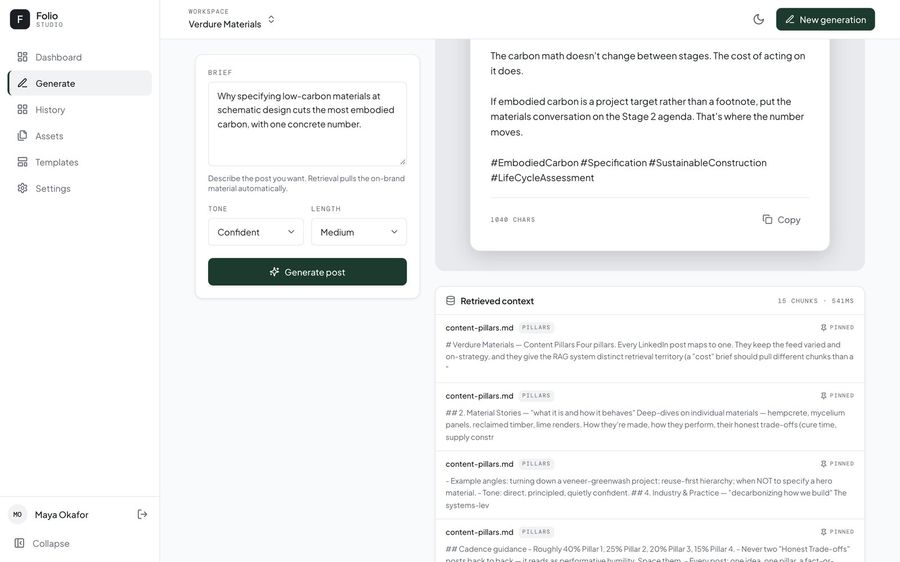
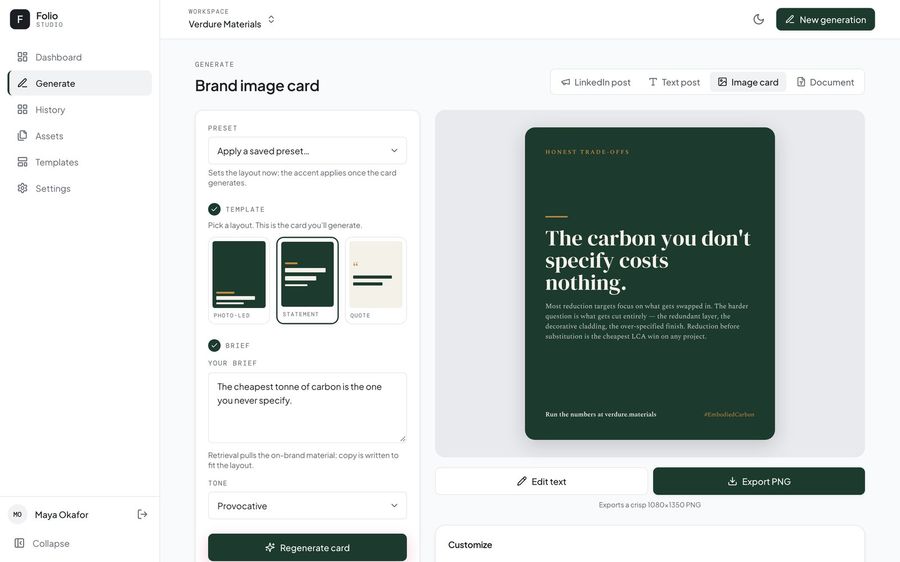
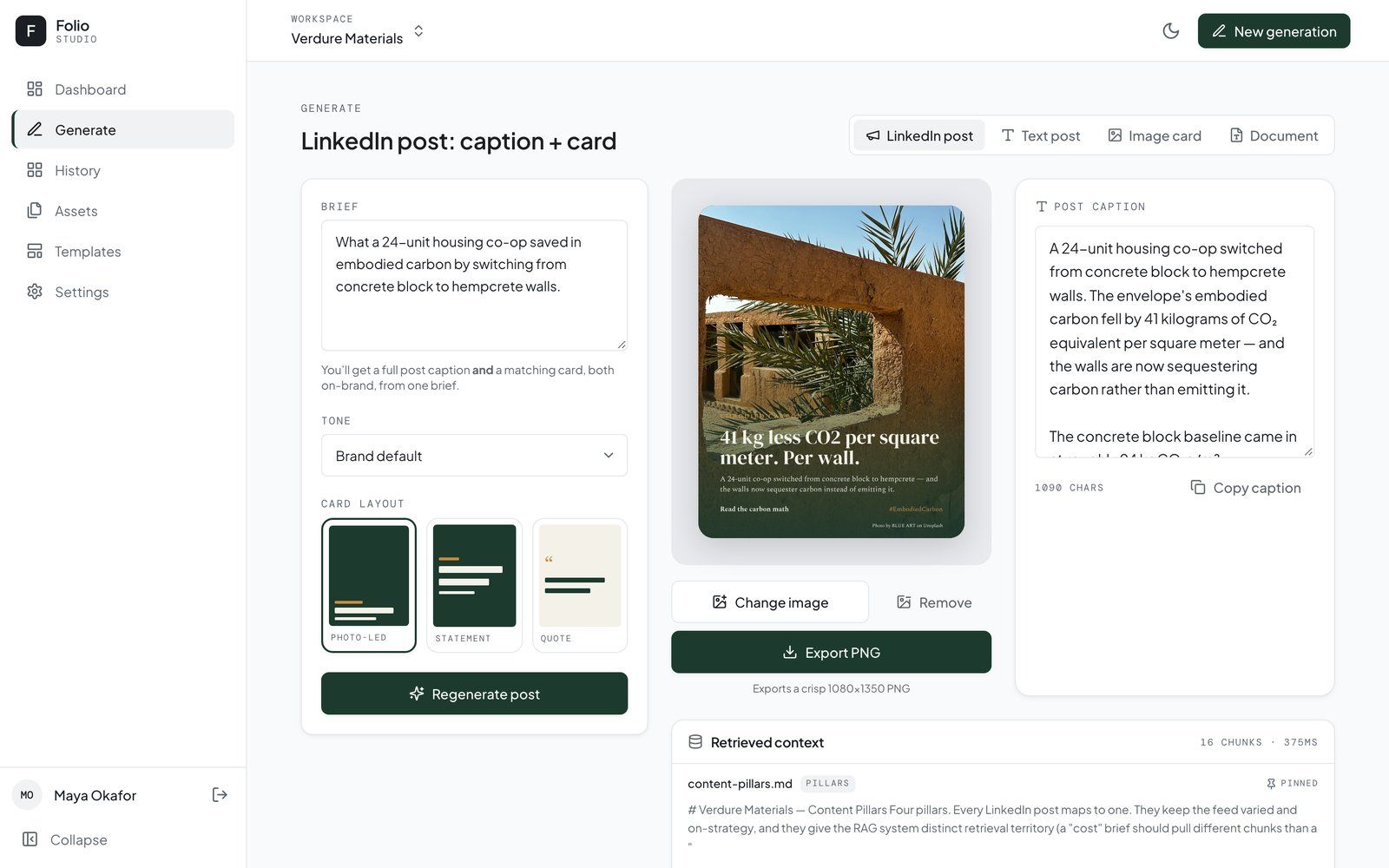
Folio writes LinkedIn posts, designed image cards, and branded documents that sound like a specific company. It indexes each brand's voice guides, past posts, and personas, then retrieves the right pieces at generation time so Claude writes on-brand instead of generic copy. Each brand lives in its own workspace, and every generation records which passages it used.
02Key features
- One workspace per brand, with its own documents, palette, fonts, and voice
- LinkedIn posts and 1080x1350 image cards, with the preview identical to the exported PNG
- Branded documents exported to Word, PDF, and PowerPoint
- "Learn from an image": upload a logo or brand guide and Claude proposes colors, fonts, and voice for review
- Every generation shows which brand passages it used and their scores
03How the AI works
Retrieval decides what Claude sees; two passes decide how it writes.
- Voice and content-pillar passages are always included, plus the top 6 semantic matches, fetched together and deduplicated.
- The copy streams over SSE into the live preview.
- A strict forced tool call then returns the structured fields: headline, body, CTA, hashtag.
- Retrieved brand material is escaped inside a fenced block to resist prompt injection.
04Tech stack
- AI
- Claude Sonnet 5.5, Anthropic SDK, OpenAI text-embedding-3-small, LangChain text splitters
- Frontend
- React 19, TypeScript, Vite, Tailwind CSS v4, shadcn/ui, Satori and resvg (PNG rendering)
- Backend
- Python, FastAPI, Pydantic v2, server-sent events, ReportLab
- Data
- MongoDB (Motor), Chroma vector store (one collection per workspace)
- Infra
- Docker, GitHub Actions, AWS
05Architecture
Index brand material
- Upload
- Parse
- Chunk800 characters, 120 overlap
- Embed
- StoreOne vector collection per workspace
Generate
- Request
- RetrievePinned plus top 6
- PromptBrand context fenced
- Claude streams copy
- Forced tool callStructured fields
- Render and saveWith a retrieval snapshot
06Results and evals
| Measure | Result |
|---|---|
| Retrieval hit rate at 6 (8 briefs) | Threshold 0.75, scored on a lexical test store |
| Automated tests | About 456 (296 server, 160 client) |
| July security audit | 1 critical, 7 high, all fixed |
| October QA pass | 17 issues, all fixed |
Every generation also saves a snapshot of the passages it used and their scores.
07Decisions and lessons
- No framework. The pipeline is four steps, so it's written directly on the SDKs instead of LangChain.
- Vector store. Chroma and Qdrant over Pinecone, on cost.
- Hosting. ECS over Lambda, because cold starts hurt streaming.
- Pinned pillars. Content pillars were being crowded out of retrieval, so they are now always included.
08Screenshots